

Grit culture in trucking is defined as the combination of perseverance, discipline, and adaptability that enables drivers and carriers to sustain performance through long hauls, market downturns, and daily operational pressure. This is not a motivational slogan. It is a lived set of behaviors, from completing pre-trip inspections before dawn to refusing low-paying freight during a recession, that keeps the supply chain moving when conditions get hard. Understanding what grit culture means in trucking helps explain why the profession demands more than technical skill. It requires a particular kind of mental toughness that is built over miles, not handed out at orientation.
What is grit culture in trucking, and how does it show up every day?
Grit culture in trucking is best understood through daily professional discipline. Industry grit combines discipline and adaptability as the backbone for drivers facing career-defining obstacles. That means the culture is not abstract. It lives in the habits a driver maintains when no one is watching.
Veteran drivers describe grit as the ability to solve problems without waiting for help. Before GPS became standard, self-reliance in analog tools like paper maps and CB radios was the baseline skill. That tradition of self-sufficiency still shapes how experienced drivers approach unexpected breakdowns, route closures, and shifting delivery windows.

Managing fatigue and isolation is another daily test. Long-haul drivers spend days away from family, navigating weather systems, traffic, and regulatory changes, all while staying alert behind the wheel. The grit mindset in drivers is what converts those pressures into routine rather than crisis.
Here are the core grit-driven habits that define a professional driver’s day:
- Completing thorough pre-trip and post-trip inspections without shortcuts
- Staying focused during overnight or extended driving windows
- Adapting routes in real time when weather or traffic demands it
- Maintaining composure during difficult shipper or receiver interactions
- Keeping up with Hours of Service regulations and electronic logging requirements
- Tracking fuel efficiency and load weight without prompting
- Communicating proactively with dispatch when conditions change
Pro Tip: Drivers who treat pre-trip inspections as a non-negotiable ritual, rather than a formality, consistently report fewer roadside violations and greater confidence on unfamiliar routes.
1 in 5 drivers face significant obstacles requiring patience and persistence to resolve. That figure reflects how frequently the profession demands more than driving skill. It demands the kind of steady resolve that does not make headlines but keeps freight moving.
How does grit influence carrier survival during freight downturns?
Grit in trucking extends beyond the cab. For owner-operators and small fleet owners, it shows up in financial discipline and the willingness to make hard calls when the market turns against them.
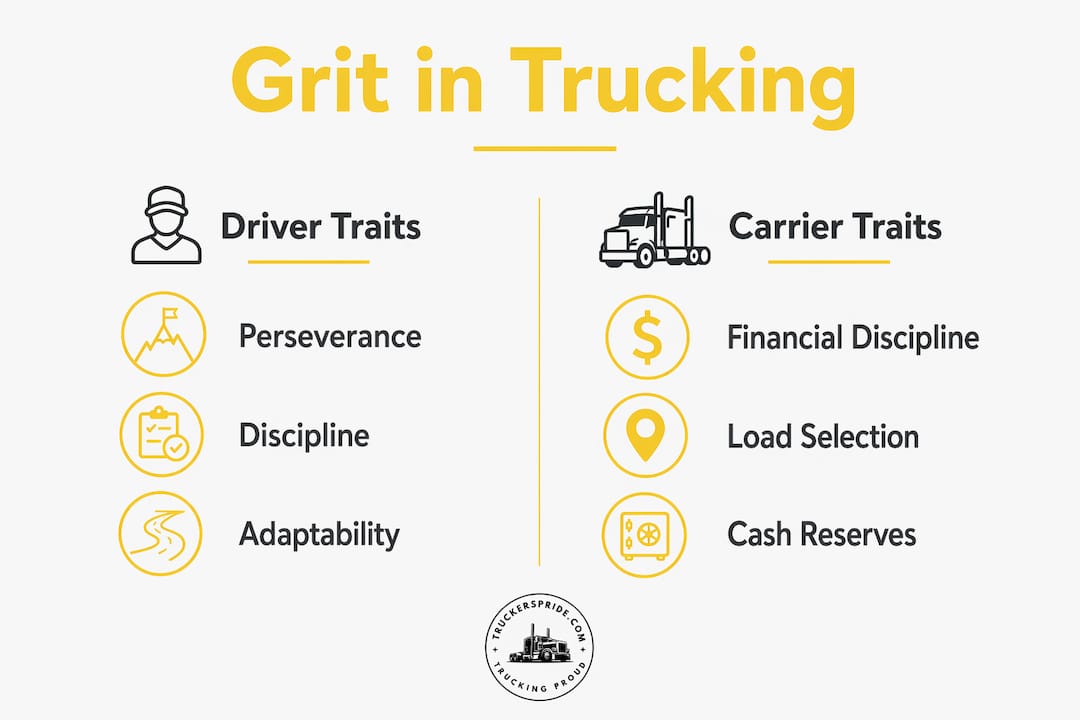
During the 2025 freight recession, owner-operators focused on loads paying $3–$5 per mile over 300–500 miles to protect margins. That is a concrete example of grit as business strategy. Refusing a load that does not cover costs takes more discipline than accepting it, especially when the pressure to keep trucks moving is constant.
Maintaining a cash reserve is another marker of fiscal grit. Small fleet owners who survived downturns consistently prioritized paying consistent salaries and cutting unprofitable lanes before the situation became critical. That kind of forward-thinking discipline separates carriers who endure from those who fold.
| Strategy | Profitable carriers | Unprofitable carriers |
|---|---|---|
| Load selection | Refused loads below target rate per mile | Accepted any load to keep trucks moving |
| Cash management | Maintained operating reserves | Operated without financial buffer |
| Lane discipline | Cut unprofitable lanes early | Held onto losing lanes hoping for recovery |
| Growth approach | Prioritized sustainable, steady growth | Chased volume at the expense of margin |
Pro Tip: Small fleet owners who set a firm minimum rate per mile before a downturn begins are far better positioned to hold that line when brokers push back during slow freight cycles.
Small carrier leaders emphasize grit as more vital than luck for sustained success. Luck determines a good week. Grit determines whether a carrier is still operating three years later.
How has grit culture evolved from rugged individualism to driver-centric models?
The traditional image of trucking grit was a solo driver handling everything alone. That model valued toughness and self-sufficiency above all else. The expectation was simple: handle it yourself, keep moving, and do not complain.
Modern trucking culture has not abandoned those values. It has built structure around them. The 2026 Best Fleets to Drive For use quarterly advisory boards, driver milestone programs, and regular retention calls to create a culture where grit is supported rather than just expected. That shift matters because unsupported grit burns drivers out. Supported grit builds careers.
Driver advisory boards give experienced drivers a formal voice in operational decisions. That is a meaningful change from the older model, where driver feedback rarely reached management. When drivers feel heard, their commitment to the job deepens. The grit mindset becomes a shared value rather than a personal survival strategy.
Cultural practices that build grit across modern fleets include:
- Quarterly driver advisory board meetings with documented follow-through
- Monthly one-on-one retention calls between drivers and fleet managers
- Milestone recognition programs for safe driving records and years of service
- Transparent communication about route changes, pay structures, and policy updates
- Peer mentorship programs pairing new drivers with experienced road veterans
- Consistent home-time scheduling that respects driver commitments outside work
The shift from rugged individualism to collaborative grit does not weaken the culture. It makes it more durable. Drivers who feel respected stay longer, perform better, and carry the values of the profession forward.
Why is grit especially significant for underrepresented drivers?
Grit carries extra weight for drivers who enter trucking facing skepticism from the start. Women, in particular, have had to demonstrate competence in an environment that did not always expect them to succeed.
Sue Bell’s story is one of the clearest examples of this dynamic. Women drivers use doubt as fuel to persevere and prove their abilities in a male-dominated profession. Bell did not ignore the skepticism she encountered. She converted it into focus. That is a precise description of how grit functions: it takes external pressure and redirects it into professional excellence.
Mentorship and community support are vital grit multipliers for underrepresented drivers. No one builds resilience in isolation. Shared experience, practical guidance, and the knowledge that others have navigated the same obstacles all strengthen a driver’s ability to persist.
Grit-building strategies drawn from personal stories of perseverance in trucking:
- Identify a specific obstacle and name it clearly rather than treating it as a general difficulty.
- Find at least one mentor who has faced a similar challenge and ask direct questions.
- Set a short-term performance goal that is entirely within your control.
- Document small wins to build evidence of competence against doubt.
- Connect with a professional community, such as Women In Trucking, to normalize shared experience.
Grit as a value transcends demographics. The discipline required to complete a 600-mile run safely, manage a difficult delivery, or hold a rate during a slow market does not belong to any one group. It belongs to the profession. What changes is the additional weight some drivers carry getting to the starting line.
Key Takeaways
Grit culture in trucking is a lived discipline combining daily habits, financial decisions, and mutual support that sustains drivers and carriers through the hardest conditions the industry produces.
| Point | Details |
|---|---|
| Grit is daily discipline | Pre-trip inspections, fatigue management, and route adaptability are grit in practice, not theory. |
| Fiscal grit saves carriers | Refusing low-paying loads and maintaining cash reserves separates surviving carriers from those who fold. |
| Collaboration strengthens grit | Driver advisory boards and retention programs build durable grit culture across modern fleets. |
| Grit multiplies with support | Mentorship and community connection increase resilience for all drivers, especially those facing added skepticism. |
| Authentic grit shows in crisis | How a company handles home-time and driver welfare during disruptions reveals whether its grit culture is real. |
Grit is not a slogan. It is a standard.
After years of watching how trucking companies talk about their culture versus how they actually operate, one pattern stands out clearly. The companies that genuinely embody grit are not the ones with the most aggressive branding. They are the ones that respect driver welfare during crises and honor scheduled home-time even when it is inconvenient.
Mike McCarron’s observation cuts to the heart of this: fleet owners sometimes mistake visibility for value, treating trucks as trophies while overlooking what drivers actually need. A shiny fleet with poor pay and unreliable home-time is not a grit culture. It is a performance of one.
Real grit culture shows up in pay structures that reflect the difficulty of the work. It shows up in equipment that is maintained properly, not just polished for trade shows. It shows up in the willingness to turn down freight that would compromise a driver’s rest or safety. Those are not glamorous decisions. They are the right ones.
The trucking industry has always attracted people with genuine resilience. The profession selects for it. What changes over time is whether the companies those drivers work for are worthy of that resilience. The best ones are. They build cultures where grit is recognized, rewarded, and sustained, not just expected and consumed.
— Sylvain
Gear that carries the same pride you do
The grit that defines trucking culture deserves to be worn with the same conviction it is lived. Truckerspride designs apparel specifically for drivers who understand what long miles and hard decisions actually feel like.

The Everyday Essentials Bundle brings together the core pieces a driver reaches for on and off the road, printed locally in North America and built for the demands of the profession. For drivers who want a single piece that says it plainly, the “We Don’t Stop When We’re Tired” Classic Trucker Cap carries the message without needing explanation. Truckerspride gear is not a costume. It is a statement made by people who have earned the right to wear it.
FAQ
What is grit culture in trucking?
Grit culture in trucking is the combination of perseverance, discipline, and adaptability that drivers and carriers rely on to perform consistently through long hauls, market pressure, and daily operational challenges. It is a lived set of behaviors, not a motivational concept.
How does grit show up in a truck driver’s daily routine?
Grit shows up in pre-trip inspections, fatigue management, real-time route adjustments, and maintaining professionalism under pressure. Industry research confirms that 1 in 5 drivers regularly face significant obstacles that require patience and persistence to resolve.
Why is grit important for small carriers during a freight recession?
Grit gives small carriers the discipline to refuse unprofitable loads and maintain cash reserves when the market softens. Carriers who held firm on rate discipline during the 2025 freight recession were far more likely to remain operational than those who chased volume at low margins.
How has grit culture changed in modern trucking?
Modern grit culture has shifted from pure individual toughness to a driver-centric model that includes structured feedback, milestone recognition, and mentorship. The 2026 Best Fleets to Drive For demonstrate this through quarterly advisory boards and consistent retention programs.
How can underrepresented drivers build grit in trucking?
Underrepresented drivers build grit by naming specific obstacles, seeking mentors with shared experience, and connecting with professional communities. Sue Bell’s story shows that external skepticism, when redirected, becomes a source of focus and professional motivation rather than a barrier.